

To avoid an expensive, underutilised CRM, Salesforce implementations must prioritise business goals over software deployment, driving user adoption from day one through a structured six-phase roadmap (Planning, Design, Data Migration, Integration, Testing, and Deployment)
Salesforce implementation delivers real ROI only when you define business goals first, migrate clean data, customize carefully, and drive user adoption from day one; otherwise, the CRM becomes another expensive tool that teams ignore.
Best Salesforce Implementation Guide
- Starting the journey towards Salesforce implementation can be life-changing for your organisation.
- Nonetheless, its effectiveness is strictly contingent on the plan being scheduled correctly.
- The best guide for Salesforce implementation is to envision and link business needs to the platform’s solutions, promote collaboration, and keep the big picture in mind throughout the process.
Key factors to consider:
- Understanding Business
- Needs: Don’t jump into implementation without taking stock of your business processes, challenges, and objectives. The biggest strength of Salesforce is the ability to follow the organization’s unique needs, but it is crucial to know what is to be achieved.
- Setting Realistic Goals: The entire process must be divided into more manageable, comprehensible steps. It is necessary to set goals to determine in which areas success can be achieved, for instance, customer retention and sales efficiency.
- Engaging Stakeholders: The management, IT, and end-users work together to ensure that the system serves everyone’s needs and demands well. The main advantage is that early involvement leads to smooth organizational adoption.
- Partnering with Experts: Engaging Salesforce consulting partners or certified professionals can provide invaluable insights and make the job much easier.
-


The services that this cloud provides are as follows
Salesforce provides a set of products and services that enable cloud computing for businesses in a unique way. Understanding these services helps in selecting the right tools for your implementation:
- Sales Cloud: This module focuses on enhancing sales processes by providing tools for lead management, opportunity tracking, and sales forecasting.
- Service Cloud: Improves customer care by serving as a case management tool, a DIY platform, and communication tools.
- Marketing Cloud: Enables businesses to develop targeted marketing messages across the right media touchpoints.
- Commerce Cloud: Optimizes the e-commerce process and provides features for retailers’ shops and customers’ interactions.
- Experience Cloud: Enables participation and collaboration via open branded and branded client-accessible portals and community areas.
- Tableau and Analytics: Combines comprehensive information display with rich facilities to make precise decisions.
Each service is made compatible with this one application to provide end-to-end, customised services for different kinds of businesses.
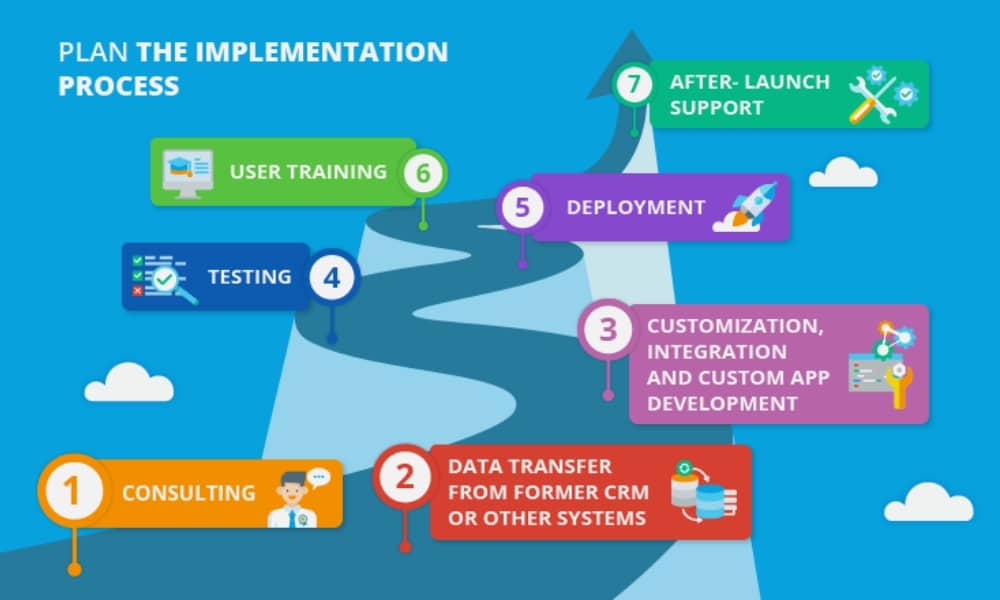
In the discussion on the specific phases of Salesforce implementation, the following fundamental steps have been identified and will be described in brief below:
The systematic use of Salesforce facilitates the correct implementation of best practices. The following stages outline the process:
Planning and Discovery:
- Therefore, it is important to define objectives and key performance indicators (KPIs).
- Conduct a gap analysis to identify areas that need improvement.
- Bring in a team to lead the implementation of an external collaboration tool.
Design and Customisation:
- Salesforce skills for achieving business processes.
- Customize settings including workflow, automatic rules, and related data fields.
- Alter the format of dashboards and reports as per the stakeholder.
Data Migration:
- Preprocess data already in a database and normalize it to support subsequent data analysis steps.
- If you want to migrate to Salesforce, the suggested tools are the platform’s data input tools or APIs.
- Data validity assessment must be done after data migration.
Integration:
- Link Salesforce to other software from different brands, such as ERP systems or marketing automation tools.
- To enable high-quality data transfers, adopt application program interfaces; API or middleware for secure and efficient data exchange.
Testing:
- Keep a finger on the pulse, check on the problems frequently and assertively.
- Bring end-users into user acceptance testing (UAT) to gather their comments.
Deployment:
- Implement in phases, but for the first instance, the process should involve a pilot group.
- It is also important to constantly assess how well or poorly employees are performing and then take steps to rectify the situation.
User Training and Adoption:
- Make sure to provide detailed training based on the user’s specific position.
- Develop clear, concise guides and handbooks, answer common questions, and provide special assistance.
- Promote adoption by rewards and share success stories.
Frequently Asked Questions (FAQs)
1. How long does the usual Salesforce implementation last?
The time it takes to implement Salesforce depends on the complexity of an organization’s operations. The average time for an ERP implementation to occur varies from as little as six weeks, for instance, where only basic features of the software are to be utilized, to as long as six months to a year or so for large-scale implementation in a company.
2. How much does it cost to use Salesforce?
The cost of the main products is determined by several indicators – the number of users, additional customizations, integrations, and support services. Any organization seeking to estimate these costs can engage a Salesforce consulting partner.
3. Who needs a Salesforce consulting partner for implementation?
- It is possible to implement Salesforce independently within the company, but a consulting partner is more likely to ensure a much better implementation process.
4. Another important question seems to be: How to guarantee the effective usage of the system by users after its implementation?
- Major tactics for establishing user acceptance are custom training, development of a high-quality interface, ongoing support, and sharing success stories from the system’s initial use.
5. Is it possible to have Salesforce interconnect with tools and apparatus already installed?
- Of course, Salesforce offers strong integration options through APIs, middleware such as MuleSoft, and tools that enable it to connect with customer ERP solutions, marketing platforms, and other third-party software.
Take Away!
Salesforce deployment goes beyond simply procuring the newest IT solution; it means formulating a new organizational paradigm. A successful implementation strategy is the result of adequate planning, the proper selection of Salesforce services to implement, and the engagement of relevant stakeholders throughout the process. Finally, most crucial is the key user adoption no system can be great if the targeted users and customers are not adopting the system.
Working with senior Salesforce consultants as your partners can ultimately lead to positive outcomes and success in the data migration process. Salesforce’s flexibility and scalability are such that, regardless of whether you are a small business or a large enterprise, you will be able to find numerous opportunities for expansion and creativity.
Check out: 4 Salient Components of the Salesforce DevOps Process