


Effective end user training programs are continuous, role-based processes with reporting channels and measurement. A yearly slide deck does not meet that standard. NIST’s 2024 guidance describes a life cycle of planning, design, delivery, and assessment aimed at behavior change. This guide is for IT managers, security leads, and small business owners who must justify and design cybersecurity training. A 2025 randomized study of 19,500 employees found that common phishing training produced little measurable protection. For that reason, end user training programs work best as one layer alongside technical controls, not as the main defense.
Why End User Training Programs Matter for Cybersecurity
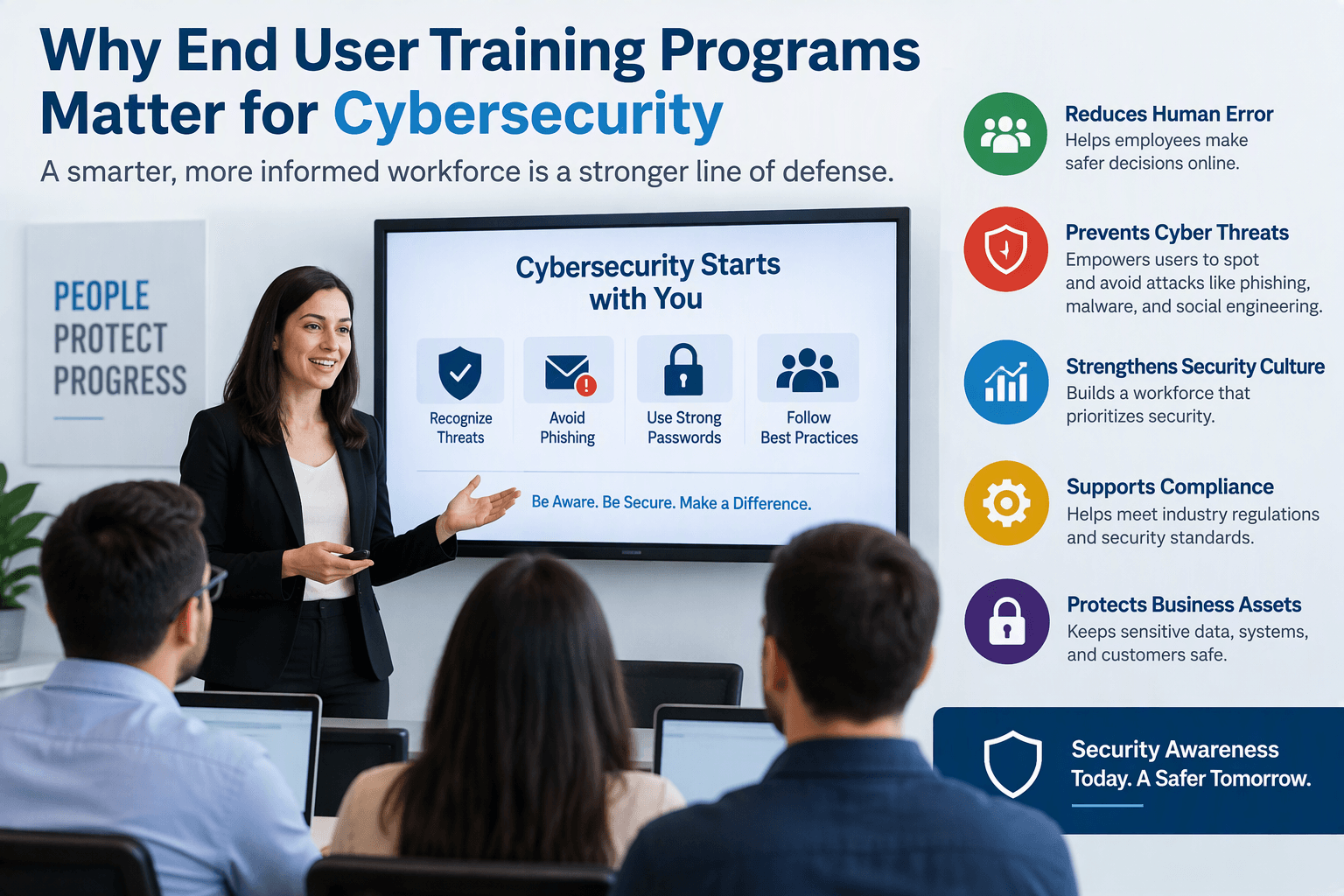
End user training programs matter because people drive a large share of breaches, and training addresses part of that risk. Verizon’s 2026 report, as summarized by security vendors, puts the human element at 62% of confirmed breaches, up from 60% in 2025. Those summaries are secondary. Verizon’s own landing page, meanwhile, highlights that software vulnerabilities have overtaken stolen passwords as the leading way in.verizon+2
The “human element” label is broad. It covers errors, stolen credentials, and social engineering, so it does not mean 62% of breaches came from employees clicking links. Verizon’s page also says mobile threats show higher click rates, since people spot phishing emails more easily than texts and calls. Training content should follow that shift.
What the evidence says about effectiveness
The strongest independent evidence comes from a UC San Diego Health study presented at the IEEE Symposium on Security and Privacy in May 2025. It was an eight-month randomized trial in which researchers sent ten phishing campaigns to more than 19,500 employees. It found no significant relationship between recently completing annual training and falling for phishing.
Embedded training, shown after someone clicks a simulated lure, reduced clicking by about 2%. About 75% of users spent a minute or less on the material, and a third closed it at once. By the eighth month, more than half of employees had clicked at least one phishing link.
One detail matters for design. An HR Reporter summary of the paper says people who completed interactive training were about 19% less likely to fail later tests, while static training showed no such link. That is an association among users who finished, not proof that interactive content causes the drop, because motivated people may both finish and behave more carefully.
The researchers recommended stronger technical controls, such as two-factor authentication and domain-checking password managers. The study came from one large healthcare employer so that results may differ elsewhere.
What Compliance Requires From End User Training Programs
Several regulations require training, but they set a floor and not a design. Meeting them proves a program exists. It does not prove the program reduces risk.
HIPAA
The Security Rule at 45 CFR 164.308(a)(5) requires covered entities and business associates to implement a security awareness and training program for all workforce members, including management. HHS lists four implementation specifications: periodic security updates, protection from malicious software, log-in monitoring, and password management. The rule does not set a fixed training interval, so organizations define their own and document the reasoning.
PCI DSS
PCI DSS v4.0.1 Requirement 12.6 requires a formal awareness program, a review at least every 12 months, and training on hire and at least annually. Requirement 12.6.3.1 adds that content must cover phishing, related attacks, and social engineering. These readings come from compliance vendors summarizing the standard, so confirm exact wording against the PCI Security Standards Council text before citing it in an audit.
Government baselines
The UK government’s cyber security handbook says programs should reflect how people actually work, set realistic expectations for what training can change, and teach staff what counts as an incident and how to report it. It also points to the NCSC’s free “Top tips for staff” material and its Suspicious Email Reporting Service.
How to Build End User Training Programs Step by Step
A workable program follows the same sequence NIST describes: plan, analyze, develop, deliver, then assess and improve. Skipping the analysis step is the most common failure, because content ends up generic.
Step 1: Define audiences and risks
NIST’s guidance starts by identifying learning needs from work role activities, then identifying the audience, matching needs to each group, and assessing their current knowledge. An accounts payable clerk faces invoice fraud. A developer faces secrets in code repositories. A help desk agent faces password-reset pretexting.
Use incident history, audit findings, and your actual threat exposure to choose topics. A single course for everyone wastes most people’s time and under-serves high-risk roles.
Step 2: Choose formats and cadence
Mix short onboarding modules, periodic refreshers, and event-driven lessons after new threats or incidents. The UCSD results suggest that passive content people skim does little, so favor interactive, short, role-specific exercises. Keep each unit focused on one behavior, such as verifying a payment-change request by phone.
Step 3: Set up reporting before testing
Staff need a one-click way to report suspicious messages and a clear promise that they won’t be punished. The NCSC states that blaming users for clicking does not work, that simulations can erode trust, and that employees afraid for their jobs will not report mistakes. It also says training, particularly phishing simulation, is often over-emphasized in phishing defenses.
A reporting culture gives the security team an early warning system. Staff reports can reveal attacks that filters miss.
Step 4: Pair training with technical controls
Training should never be the only barrier. The UCSD authors point to multi-factor authentication and password managers that refuse to fill credentials on the wrong domain. These controls work even when someone is fooled. Email filtering, link protection, and mailbox rules belong in the same plan.
Minimum control set to run alongside training
- Multi-factor authentication on email, VPN, and admin accounts
- A built-in report-phishing button in the mail client
- Filtering that quarantines known malicious messages
- Approval steps for payment or banking-detail changes
Measuring End User Training Programs
Measurement should show whether behavior and incident outcomes change, not only who finished the course. NIST’s guidance includes suggested metrics and evaluation methods to improve the program regularly. Completion rate shows the program runs, but not that it works.
Metrics that carry meaning
Track report rate as well as click rate. One security vendor summary of the 2026 DBIR notes that only about 20% of people report simulated phishing, and recommends tracking report rate as a primary resilience measure. Treat that as a vendor interpretation of the data. Also track time to report, repeat incidents by team, and findings from real incidents.
Click rates alone mislead. The UCSD study found some lures drew 30.8% clicks, such as a fake vacation-policy update, while a fake Outlook password update drew 1.82%. Lure design changes yield more than training does, so compare like with like.
Simulation cautions
Run simulations to practice reporting, not to rank people. Publishing click lists or disciplining failures damages trust, as the NCSC warns. Rotate lure types, including text and phone-based scenarios, since attackers have moved toward mobile.
Common Mistakes in End User Training Programs
Most failed programs share a few problems. They treat training as a compliance checkbox, measure completion instead of behavior, and punish mistakes. Each one reduces reporting and masks real exposure.
Other failures follow from the evidence above. Long annual videos that people click through show no link to lower phishing failure. Generic content ignores role risk. Programs that ignore text-message and voice scams leave a growing gap, given Verizon’s note on mobile click rates.
Overclaiming is a related risk. No source supports a guaranteed reduction from any program, and the UCSD authors say organizations should not expect commonly deployed training to substantially protect against phishing—present training to leadership as marginal risk reduction, supported by technical controls.
Priority Actions for End User Training Programs
Start with controls and reporting, then build role-based training around real incidents. First, enable multi-factor authentication and a report button. Second, split audiences by risk and write short, interactive lessons on each group’s top three behaviors. Third, measure report rate, time to report, and real incidents, and review the program at least annually to meet PCI and similar requirements.
The main trade-off is effort against evidence. Role-based, interactive training costs more to build than a purchased annual course, and published research shows only modest benefit even then. The practical result is a stronger cybersecurity posture that satisfies auditors, gives staff a safe way to raise concerns, and does not depend on every employee spotting every attack.