
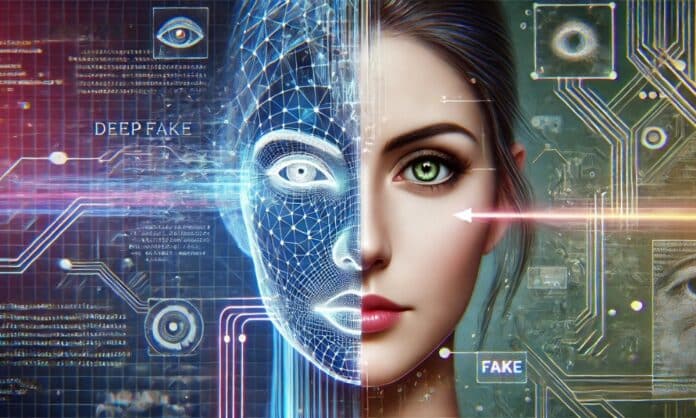

I’ve watched deepfakes and identity verification systems fail in real time, and I’ve seen organizations lose millions because they trusted what they saw on screen. Here’s what’s actually happening with deepfakes and identity verification—and why the future is darker than vendors admit.
The Reality: Deepfakes and Identity Verification Detection Tools Are Already Broken
The gap between what deepfake detection vendors claim and what actually happens in production is now a chasm.
- Lab accuracy: 95-98%
- Real-world accuracy: 45-50% lower
This isn’t theoretical. Commercial deepfake detection tools drop 45-50% in accuracy when they leave the laboratory. Sensity AI claims 95-98% accuracy. Against real Zoom calls with compression artifacts? You’re looking at actual performance in the 70-80% range. Intel’s FakeCatcher performed at 96% in testing, then 91% on real deepfakes collected from the internet—a 5% drop that’s actually better than most tools.
Why? Labs test on high-quality video. Fraud happens on compressed video calls with network latency, poor lighting, and partial face visibility. Your detection tool was trained on data that doesn’t exist in the real attack landscape.
Worse: Deepware achieved 93.47% accuracy in testing, but open-source detection models manage only 61-69% on real-world datasets. If you’re relying on free tools, expect to miss 30-40% of deepfakes.
The structural problem: Detection is always reactive, never proactive. By the time vendors release an update to catch new deepfake generation techniques (diffusion models, next-generation transformers), attackers have already moved to the next method.
Why Deepfakes and Identity Verification Matter Now: 2026 Is When Everything Changes
Voice cloning has reached a point where audio authentication is essentially dead.
Current platforms (Narration Box, DupDub, Voice.ai, Speechify Studio, Descript) can clone a voice with stunning accuracy from just 10-30 seconds of audio. That’s a LinkedIn video. That’s a YouTube presentation. That’s an internal all-hands recording your company has archived.
An attacker can:
- Record 30 seconds of your CFO from any public video
- Upload to a voice cloning service ($100-500)
- Generate a spoofed call impersonating the CFO
- Instruct an employee to wire money or reset passwords
- Voice verification systems pass the clone 95% of the time because the clone actually matches the CFO’s voice pattern
Voice authentication is no longer a security control. It’s a liability.
The Discord breach of October 2025 proved this is now an operational reality. 70,000 government ID photos were exposed through a third-party vendor breach (5CA), not through Discord itself. These aren’t theoretical training datasets—they’re real identity documents, names, IP addresses, and contact information in criminal hands right now.
What makes this devastating: A sophisticated attacker now has what they need to build deepfakes that bypass identity verification systems. They have your government ID photo. They have your voice from public videos. They have your email, phone number, and social patterns from LinkedIn. They don’t need to hack your company. They just need to synthesize you.
The Cascade: How One Breach Enables the Next Attack
The real threat isn’t a single compromise. It’s the cascade.
When Coinbase was breached in 2024, attackers stole names, emails, phone numbers, and partial SSNs of tens of thousands of users. Combined with Discord’s leaked government IDs, an attacker can:
- Reference specific account details your employee already provided (because the data is stolen)
- Call with a voice clone of the employee’s manager
- Sound urgent and informed
- Authenticate successfully using stolen data as verification
This is a cascading identity verification failure: one breach creates the training data for the next attack, which enables the authentication bypass for the fraud.
What Actually Stops Deepfake Fraud (And What Doesn’t)
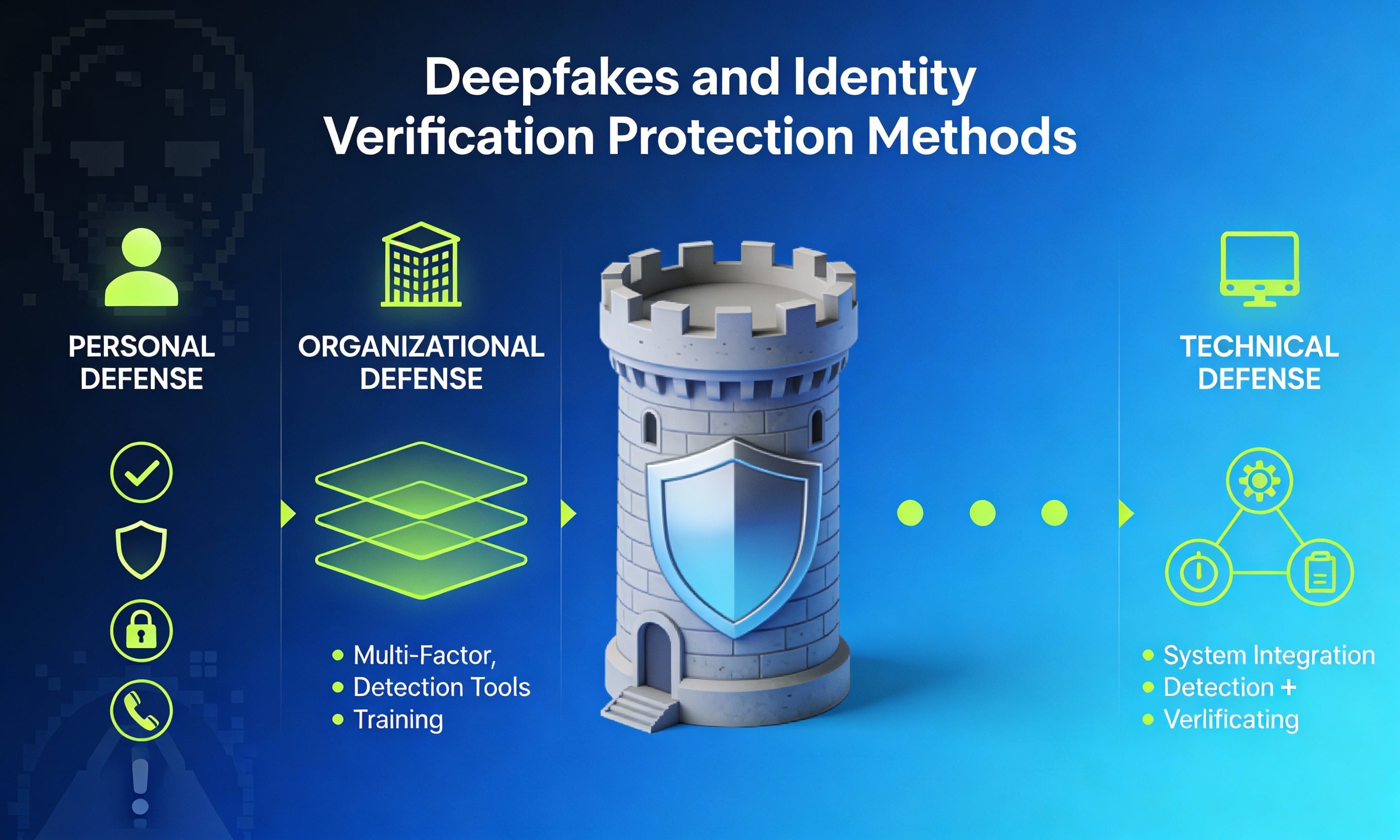
What doesn’t work?
Trusting the video as proof. Deepfakes pass facial recognition tests 80%+ of the time. Asking unexpected questions. Sophisticated deepfakes trained on extensive footage respond naturally to off-script questions. Using a single detection tool. Tools drop 45-50% accuracy in production—no tool catches everything. Relying on biometric authentication alone. The Discord breach exposed 70,000 government IDs.
What actually works?
Layer 1: Stop trusting what you see.
This is non-negotiable. If someone on video or phone asks for money, access, or sensitive data, hang up immediately. Use a phone number from your own records. Contact the person through a completely different channel. Verify independently.
This single step stops 90%+ of deepfake fraud because attackers rely on you acting in the moment. Remove the moment, and the fraud collapses.
Layer 2: Add behavioral verification.
Does your CFO normally request wire transfers via video call? Is this request consistent with how this person usually communicates? Are they asking for something they normally wouldn’t?
Behavioral verification catches fraud that technological tools miss. It costs nothing and requires no infrastructure. Just document how each executive normally communicates and flag deviations.
Layer 3: Add time delays for high-value transactions.
In 2025, forward-thinking financial institutions started requiring 15-30 minute delays between authorization and execution. This window allows verification calls, secondary approvals, and account checks before the transaction irreversibly executes.
Sophisticated attackers struggle with delays. Their entire attack model relies on artificial urgency. Remove the urgency, and the fraud collapses.
Layer 4: If video is involved, layer every verification type together.
Real-time deepfake detection software (Sensity AI, Reality Defender) scans the call. Liveness tests prove they’re a living person. Biometric verification (fingerprint, iris scan) can’t be deepfaked in real time. Voice biometrics verify that they actually sound like the person. All signals must agree before any transaction executes.
This makes the attack so expensive and complex that most attackers move to easier targets.
Layer 5: Protect your executives’ digital footprint.
Deepfakes require training data. The more video content your CEO has publicly available (LinkedIn videos, YouTube presentations, company recordings, archived news footage), the easier it is to build a convincing deepfake.
You don’t need to hide your executives. You just need to be deliberate: limit full-length videos, avoid extended interviews without a strategic reason, and be cautious about archived videos in searchable databases.
Every video you remove from the internet is one less data point for attackers to steal.
Layer 6: Monitor for stolen biometric data.
After the Discord breach and others, assume government IDs and biometric data are already in criminal hands. Implement adaptive authentication that cross-references biometric data against known-stolen datasets, flags when a “verified” ID matches a disclosed breach, and monitors for pattern anomalies (e.g., 50 loan applications using different stolen IDs in one week).
This won’t catch deepfakes, but it catches the credential-based fraud that precedes them.
The 2026 Landscape: What’s Actually Coming
By mid-2026, deepfake generation will be commodified further. What currently costs $300-500 and requires technical knowledge will become plug-and-play SaaS available to anyone.
- Real-time deepfakes in conversations. Today, deepfakes are pre-recorded videos. By mid-2026, AI will generate deepfake responses in real time during video calls. The deepfake will respond to unexpected questions, adapt facial expressions naturally, and maintain eye contact—making detection exponentially harder.
- Voice synthesis reaching human-level quality. 10-30 seconds of audio will generate hours of perfectly natural speech in the target person’s voice, with emotion matching and accent preservation. The barrier to entry drops from “technical expertise” to “paste a YouTube link.”
- Audio-visual synchronization defeating liveness tests. Current liveness tests ask people to blink or move unexpectedly. By 2026, AI will generate synchronized audio-visual deepfakes that pass these tests automatically.
- Detection tools are permanently lagging behind innovation. New generation methods (diffusion models, next-gen transformers) will emerge faster than detection vendors can respond. This cat-and-mouse game will only accelerate.
Why Technology Can’t Solve This
No detection tool, no matter how expensive, will reliably catch deepfakes in 2026. The 45-50% accuracy gap between lab and real-world performance is structural, not temporary. It’s not a problem that vendors can fix by throwing more computing power at it.
Technology’s role is 10%. The real defense is discipline:
- Behavioral verification (does this request make sense?)
- Secondary verification protocols (always use a separate channel)
- Time delays (remove artificial urgency)
- Layered checks (no single signal decides everything)
The organizations that stopped deepfake fraud in 2025 did it with discipline, not detection tools. They refused to trust what they saw on screen. They verified independently. They asked tough questions. They added friction to high-value transactions.
The organizations that got defrauded? They skipped the extra step. They trusted the video. They acted when they should have paused.
Your Next Move
Deepfakes aren’t a future threat—they’re operational now. Detection tools are failing in production. Stolen biometric data is already in criminal hands.
Your protection isn’t a product you buy. It’s a process you follow:
- Never act on financial requests via video or phone alone
- Always verify through a separate channel
- Add time delays to high-value transactions
- Layer multiple verification methods together
- Monitor for unusual request patterns
- Protect your executives’ digital footprint
- Assume your biometric data is already compromised
Stop betting on detection tools. Start betting on discipline.