


In-house data management gives organisations direct control over how business data is collected, secured, governed, and used. While outsourcing can reduce costs and add capacity, keeping core data operations in-house often improves data quality, strengthens governance, accelerates decision-making, and reduces security risks. For many organisations, the best approach is a hybrid model that combines internal ownership of critical data with external support for repetitive or specialised tasks.
As data becomes one of the most valuable business assets, the question is no longer whether data should be managed carefully. The real question is who should manage it, how much should remain under internal control, and where external expertise can add value without compromising quality or security.
What Is In-House Data Management?
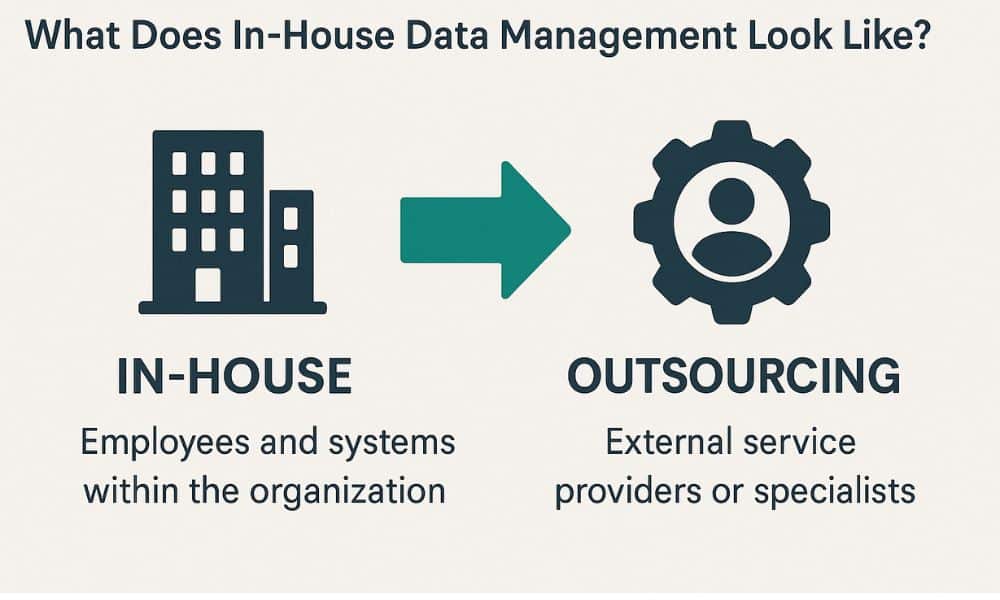
In-house data management refers to the practice of handling business data using internal employees, systems, processes, and governance structures. Internal teams oversee the complete data lifecycle, including data collection, entry, storage, validation, integration, analysis, reporting, security, and ongoing maintenance.
The primary advantage of this approach is ownership. Internal teams understand business objectives, operational requirements, customer expectations, and regulatory obligations. Because they work closely with stakeholders across departments, they can apply context that external providers often lack.
Modern in-house data management extends far beyond storing information in databases. It includes establishing governance frameworks, maintaining data quality standards, implementing security controls, and ensuring that information remains accessible and trustworthy across the organization. Research and industry guidance consistently identify governance, quality, security, and accountability as the foundation of successful data management programs.
Why In-House Data Management Matters
Organizations rely on data for everything from forecasting demand and managing inventory to measuring performance and improving customer experiences. Poor-quality information can lead to inaccurate reporting, operational inefficiencies, compliance risks, and flawed business decisions.
When data management remains internal, organizations gain greater visibility into how information is created, modified, and used. Internal ownership also makes it easier to establish consistent standards across departments.
Key benefits include:
- Greater control over data structures, access permissions, and workflows.
- Stronger alignment between data teams and business stakeholders.
- Faster resolution of data issues and quality concerns.
- Improved consistency across systems and reporting processes.
- Better protection of confidential business information.
- Clear accountability for governance and compliance.
Organizations that treat data as a strategic asset typically invest heavily in governance and quality controls because reliable analytics, automation initiatives, and AI systems depend on trustworthy information.
What Effective In-House Data Management Looks Like
Successful in-house data management is built on three pillars: people, processes, and technology.
People
Internal data professionals perform tasks such as data entry, cleansing, validation, enrichment, analysis, reporting, and governance oversight. Unlike external providers, they possess institutional knowledge that helps them identify anomalies and understand how data supports business operations.
Many mature organizations assign specific ownership responsibilities through data stewards, governance committees, and subject matter experts who ensure data remains accurate and useful.
Processes
Strong processes create consistency and accountability. Effective organizations document how data is collected, validated, stored, shared, and archived.
Common process components include:
- Data quality standards
- Validation and verification rules
- Change management procedures
- Audit trails
- Escalation workflows
- Access management policies
- Compliance monitoring
Without documented procedures, even advanced technology cannot prevent data inaccuracies or governance failures.
Technology
Internal teams typically use a combination of:
- Data warehouses
- Business intelligence platforms
- Integration tools
- Data quality solutions
- Master data management systems
- Automation platforms
- Analytics and reporting tools
Technology helps scale data operations, but governance and operational discipline remain equally important. Industry frameworks consistently distinguish data governance from data management, with governance providing oversight while management handles execution.
Advantages of In-House Data Management
Greater Control and Governance
One of the strongest arguments for internal management is control. Organizations can define their own standards, security requirements, retention policies, and access permissions without relying on external vendors.
This level of oversight is especially valuable in industries subject to strict regulatory requirements or those handling highly sensitive information.
Better Data Quality
Data quality improves when the people maintaining datasets understand the business context behind the information.
Internal teams can quickly identify inconsistencies, investigate anomalies, and collaborate with departments to correct issues before they affect reporting or operational decisions.
According to governance and quality frameworks, dimensions such as accuracy, completeness, consistency, and timeliness are critical to maintaining trusted data assets.
Faster Collaboration
Data rarely exists in isolation. Marketing, sales, finance, operations, and executive leadership all depend on shared information.
When data management functions are performed internally, communication barriers are lower, and feedback loops are shorter. Teams can collaborate directly rather than routing requests through external service providers.
Stronger Security Oversight
Although no model guarantees perfect security, keeping sensitive data within internal controls can reduce exposure.
Organizations often prefer internal management for:
- Financial records
- Customer information
- Healthcare data
- Legal documentation
- Intellectual property
- Strategic business information
Internal teams can enforce security policies and monitor compliance more closely than organizations with heavily distributed data operations.
Challenges of In-House Data Management
Despite its advantages, in-house management is not always the most cost-effective or scalable option.
Higher Staffing Costs
Building an experienced data team requires investment in recruitment, training, retention, and professional development.
As data environments become more complex, organizations often need specialists with expertise in governance, engineering, analytics, security, and compliance.
Scalability Constraints
Rapid growth can overwhelm internal resources.
Common triggers include:
- Product launches
- Mergers and acquisitions
- System migrations
- Seasonal business spikes
Large-scale data cleanup projects
Without sufficient capacity, backlogs can develop, and productivity may decline.
Specialised Skill Gaps
Organizations do not always possess every capability internally. Areas such as advanced analytics, data migration, integration engineering, and large-scale cleansing projects may require expertise that is difficult or expensive to maintain year-round.
Operational Bottlenecks
If all requests depend on a small internal team, business units may experience delays in reporting, analysis, and project execution.
The challenge is finding the right balance between control and operational efficiency.
Where Outsourcing Fits
Outsourcing involves assigning certain data-related activities to external providers. Organizations frequently outsource repetitive, labor-intensive, or highly specialized functions while retaining strategic oversight internally.
Commonly outsourced tasks include:
- Data entry
- Data cleansing
- Catalog maintenance
- Data conversion
- Document processing
- Historical data migration
The primary benefits are flexibility, scalability, and access to specialized expertise.
However, outsourcing also introduces vendor risk. Modern security and governance frameworks emphasize supplier oversight, contractual controls, risk assessments, and information security requirements when third parties access organizational data.
Organizations should evaluate providers carefully and establish clear expectations regarding quality, security, performance, and compliance.
Choosing Between In-House, Outsourcing, and Hybrid Models
The right model depends on business objectives, risk tolerance, available resources, and data sensitivity.
In-House Is Often Best When:
- Data is highly confidential.
- Regulatory requirements are strict.
- Business context is essential.
- Real-time stakeholder collaboration is required.
- Governance control is a top priority.
Outsourcing Often Works Best When:
- Workloads fluctuate significantly.
- Tasks are repetitive and standardized.
- Specialized expertise is needed temporarily.
- Internal resources are limited.
- Cost efficiency is a major concern.
Hybrid Often Delivers the Best Balance
Many organizations now adopt hybrid models.
In a hybrid environment:
- Core governance remains internal.
- Strategic analytics stay in-house.
- Highly sensitive datasets are internally managed.
- Routine processing tasks may be outsourced.
- External partners provide surge capacity and specialized support.
Hybrid approaches allow organizations to maintain ownership and accountability while expanding operational capabilities when needed. Governance experts increasingly view hybrid structures as an effective way to balance centralized control with business flexibility.
Data Quality Must Remain the Priority
Regardless of the operating model, data quality determines the value of every business report, dashboard, forecast, and AI initiative.
High-performing organizations maintain quality through:
- Defined standards and policies
- Automated validation checks
- Regular audits
- Data stewardship programs
- Continuous monitoring
- Cross-functional accountability
Research consistently shows that data quality is not simply a technical challenge. It is an organizational responsibility requiring governance, ownership, and ongoing oversight throughout the entire data lifecycle.
Final Thoughts
In-house data management remains the strongest option for organizations that prioritize control, governance, security, and business alignment. While outsourcing can provide valuable expertise and scalability, critical data ownership should remain close to the people responsible for the business