
RouterSploit on Android Device: Full Setup & Usage Guide

RouterSploit on Android Device is an advanced open-source framework configuration designed to detect and exploit security vulnerabilities in routers, IoT devices, and embedded systems. This tool can be used in combination with an Android device to allow security professionals, penetration testers, and ethical hackers to perform on-the-go assessments with minimal hardware.

In this thorough tutorial, we shall teach you to set up and to adapt a RouterSploit on Android Device: for your own uses; we will also take the time to help you understand the key parts and pieces that make the device tick and, more useful to the average reader, make it work for them. We’ll also cover all the key safety and legal pointers you need to know so that you can use this powerful tool without worry.

RouterSploit on Android Device: Why Use It on Android?
RouterSploit on Android Device
Image source: https://github.com/

RouterSploit is frequently called the Metasploit for routers. It is aimed directly at embedded devices and works through a variety of vulnerabilities. It has plenty of exploit modules, scanning tools, brute-force utilities, and credential-testing gizmos.

1. Executing “RouterSploit on Android devices provides:

  • Portability: Employing your Android phone for pretesting is possible without the presence of a laptop.
  • Wireless Access: Effortlessly connect to Wi-Fi targets when performing physical or on-site evaluations.
  • Cost-efficiency: Just a free app and some configuration, no need for pricey hardware.
  • In your personal devices and networks
  • In corporate or freelance pretesting engagements, it is imperative to have explicit permission.
  • For purposes of education or training

Do not use RouterSploit (or any similar tool) on public or private networks unless you have permission. Besides being highly unethical, using these tools without permission can lead to serious criminal charges—even if your intentions are purely educational.

3. System Requirements for RouterSploit on Android Device:

Hardware Requirements

  • Android 8.0 or higher
  • At least 2 GB RAM
  • 200–300 MB free internal storage
  • Rooted device (optional, but improves compatibility)

Software Requirements

  • Termux (preferred) or Pydroid3
  • Git
  • Python (version 3.6+)
  • Internet connection for downloading modules and updates

To install RouterSploit on Android using Termux, proceed as follows:

  1. Before installing RouterSploit, you need to set up Termux. If you haven’t already done so, download and install the Termux application from the Google Play Store or from their GitHub release page.
  2. After installing Termux, open it up and run the following command to install the necessary dependencies for RouterSploit:
    pkg install git python2 -y
  3. Next, you need to download RouterSploit from its GitHub repository. To do this, execute the following command in Termux:
    git clone https://github.com/threat9/RouterSploit.git
  4. After downloading RouterSploit, you need to navigate into the RouterSploit directory that was just created using the `cd` command:
    cd RouterSploit
  5. Now it’s time to run RouterSploit. But before doing so, make sure you have the required packages by executing the following command:
    pip2 install -r requirements.txt
  6. Finally, execute the command to run RouterSploit, and you’re done!

Obtain Termux from the F-Droid repository: Steer clear of the version available on the Play Store, as it could be an outdated iteration.

To obtain the most recent version, utilize F-Droid to download it

  1. Update package lists:pkg update && pkg upgrade

  2. Install Python and Git: pkg install python git

  3. Clone the RouterSploit repository: git clone https://github.com/threat9/routersploit

  4. Navigate to the RouterSploit directory: cd routersploit

  5. Install required dependencies:pip install -r requirements.txt

  6. Start RouterSploit: python3 rsf.py

At this point, you’ll be inside the RouterSploit command-line interface, where you can begin using its modules.

Understanding the Interface for RouterSploit on Android Device:

Once RouterSploit is operational, you will engage with it using commands akin to those used in other CLI-based security tools. Here is a breakdown of navigating through RouterSploit and utilizing its features.

1. Accessing Available Modules

To list all modules:

Run command: show modules

2. Selecting a Module

  • Use the following command to load a specific module:use exploits/routers/netgear/rom-0

This instance focuses on an understood weakness in Netgear routers. Substitute the module path with any module from the list of displayed modules.

3. Selecting Module Options

  • Once a module is selected, view its options:show options
This shows parameters like target, port, or credentials that must be set before running the module.

4. Setting Module Parameters

  • To configure a value, use the set command:set target 192.168.1.1
The target IP address for the exploit is set by this command. You can just as easily set other parameters such as usernames, passwords, and ports.

4. Running the Module

Once all necessary options are configured:run

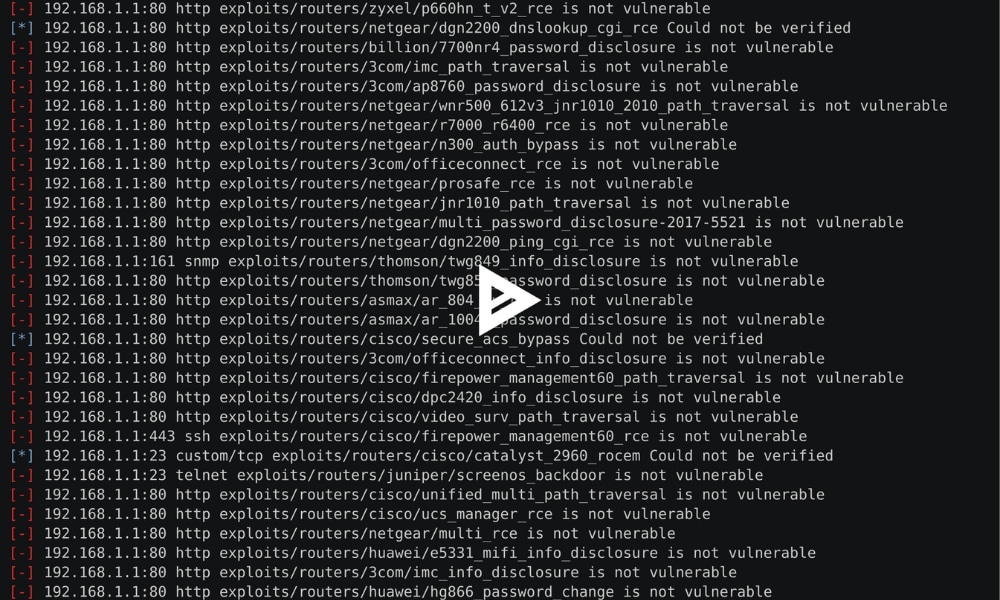
This command runs the chosen module against the set target. It shows in the output whether the target is vulnerable and indicates what actions were executed.

4. Main Features and Modules in RouterSploit

RouterSploit comprises several categories of modules that are intended for different phases of the penetration testing process.

a).Exploits

These modules house code that goes after particular vulnerabilities in devices. Each of these exploits is written for a known CVE or a vendor-specific flaw.

Examples include:

Vulnerabilities in Remote Code Execution Causes razor stuff can’t act like it must Levels of difficulty:

The command injection that occurs in Linksys devices happens when an authenticated user can execute commands in the context of the device’s OS via a hidden Web interface. The personalized commands can perform a range of tasks and can even lead to unauthorized access to the network.

b). Scanners

Reconnaissance and fingerprinting of devices on a network is achieved through the use of scanners. They help disclose such things as models of devices, versions of their firmware, and the state of their ports.

c).Payloads

Modules are often used in conjunction with exploits. These include reverse shells and code execution triggers that give deeper access to the target.

d). Credentials

This part contains modules for doing brute-force attacks on routers and their web interfaces using either default or weak credentials.

  • Telnet credential testers
  • SSH brute force modules
  • HTTP basic auth checkers

6. Example: Running a Real Router Exploit from Android

Let’s walk through a simple, real-world example using RouterSploit on Android.

  • Launch RouterSploit via Termux: python3 rsf.py
  • Load the desired module:use exploits/routers/netgear/rom-0
  • Show module options: show options
  • Set your target (router IP): set target 192.168.0.1
  • Run the exploit:run

When the router has a weakness, RouterSploit will show the outcome of the exploit—indicating if it obtained any login information or has reached the command line interface.

  • Tips for Safe and Effective Use

Always update the RouterSploit framework regularly: git pull

  • Tools such as Nmap may be usefully combined with this for better reconnaissance.
  • When conducting tests, ensure you are using VPNs or proxies to remain anonymous.
  • Store output in log files for subsequent examination.
  • Relying only on RouterSploit is not enough; you must confirm outcomes by hand

Troubleshooting Common Issues

Module Not Loading

  • Ensure all dependencies are installed using:pip install -r requirements.txt

1. Termux Crashes or Freezes

To restart Termux and clear cache, follow these steps:

  • Exit Termux.
  • Open Android settings.
  • Select “Apps”.
  • Search for and select “Termux” from the app list.
  • Tap on “Storage”.
  • Tap “Clear Cache”.
  • Now go back and tap on “Force Stop” to stop the Termux app from running.
  • Restart your Android device.
  • Open Termux again after your device fully boots up.
  • Steer clear of using multiple apps when they are demanding a lot from your computer’s resources.

2. Permission Denied” Errors

Make sure that the Termux has the permissions on the file system.
To get full access, think about executing Termux as root (on devices that are rooted).

3. Alternatives to RouterSploit on Android

If RouterSploit does not meet all of your needs, contemplate using these other tools:

  • Metasploit Framework: Advanced, comprehensive framework for penetration testing that can be set up through Termux.
  • Kali NetHunter: Kali NetHunter is the mobile penetration testing operating system for Android devices that have been rooted. It is an OS, complete in its whole, that serves as a penetration testing platform.
  • ZAnti: An Android network scanner and penetration testing tool with a GUI base.
    dSploit is a former Android application for penetration testing that allows an attacker to perform Man-in-the-Middle (MITM) attacks and network mapping. The application has not been maintained since 2015.

How to Secure Yourself from Attacks on RouterSploit on Android Device

RouterSploit is not only for attackers; it is also used by defenders to strengthen network devices. The tool is easy to use, and it comes with many helpful features. Here’s how to use RouterSploit to add an extra layer of security to your devices:

  • Regularly update the router’s firmware to patch known vulnerabilities.
  • Turn off remote management features unless absolutely essential.
  • Utilize robust administrative credentials—do not adhere to defaults.
  • Device segmentation is essential, particularly for devices that are not designed with strong security. These low-cost, low-power devices can be entry points for an attacker and should be kept separate from your core network.
  • Allow WPA3 or strong WPA2 encryption to be used for wireless access.

Final Thoughts

In 2025, working with “RouterSploit on Android Device” has never been more effective. Now you can pocket-scan for vulnerabilities, work through and test your exploit chains, and otherwise secure and pen-test your own networks, using just a few basic Android tools. That’s a pretty big leap in the last 5 years—and 4 years of actual RouterSploit development.

However, with great power comes a great responsibility to use it legally and morally. Always obtain permission before scanning or testing any apparatus you do not possess. Ethical hacking concerns itself with making the digital realm safer—not with using its access to personal advantage.

Most Popular