


Which business communication strategies are important for a company? Effective communication involves more than just exchanging ideas. It necessitates paying alert to tone, demeanor, and other factors that affect communication. Continuous focus and practice are necessary for effective business communication. Acquiring an understanding of good communication techniques can help your business and employee relations.
What is Business communication?
The process of exchanging information both inside and outside of an organization is referred to as business communication. It includes written communication, conversations, and nonverbal communication, among other kinds. Successful organizations must have effective communication because it promotes teamwork and helps accomplish organizational objectives.
Types of business communication
Understanding when to employ each of the several kinds of effective business communication guarantees impact and clarity.
- Emails, messaging, and meetings are examples of internal communication that takes place within a business to maintain team alignment.
- Public relations, marketing, and customer interactions are all examples of external communication that shapes a company’s reputation.
- For delicate discussions or urgent jobs, verbal communication is best.
- Reports and emails are examples of written correspondence. Although it serves as a record of the conversation, it must be clear to prevent misunderstandings.
- How communications are received and comprehended is influenced by body language, tone, and facial expressions.
- Reports and legal documents are examples of formal communication that adhere to structure and etiquette.
- Huddles and check-ins are examples of informal communication that promotes agility and teamwork.
Your message will be successful, professional, and clear if you choose the appropriate communication technique.
Effective Business Communication Techniques
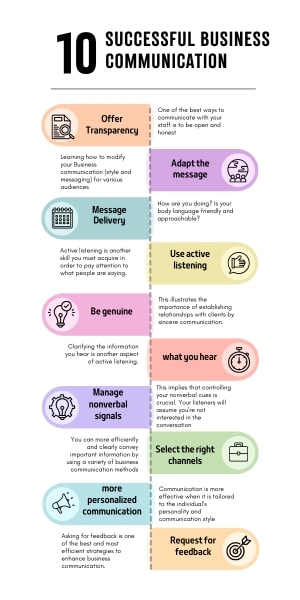
You must be skilled at asking for feedback, delivering messages, and actively listening if you want to communicate effectively. These are a few of our preferred methods for improving communication abilities.
1. Offer Transparency
One of the best ways to communicate with your staff is to be open and honest with them. Employees may get concerned that anything is amiss if information is withheld from them or if regular communication is not maintained. They will begin to fill in the gaps and make inferences, which may cause rumors to spread.
Being transparent with your staff demonstrates your trust in their honesty. Establishing trust with your staff can improve employee loyalty, lower attrition, and foster a happier workplace. Additionally, your staff could be more inclined to be candid with you in return.
2. Adopt the message to your audience
Learning how to modify your Business communication (style and messaging) for various audiences is one of the first steps toward good business communication. Your safety team is likely already aware of the issue if you are discussing a new policy with them, so you can discuss deeper into the specifics of how it will be implemented. Simplify your communication when implementing the same policy for frontline staff. You’ll probably choose a more comprehensive strategy. Describe the goal of the policy and the practical ways in which it should be implemented in their daily lives.
This holds true for every circumstance or kind of business. Depending on the subject, what you’re attempting to say, and the setting, you would speak differently to a group of kindergarteners, tech entrepreneurs, cattle farmers, and fitness professionals.
3. Get ready for the Message Delivery
How are you doing? Is your body language friendly and approachable? Are you staring at a screen or maintaining a lot of eye contact?
Prepare yourself before any business communication, including important speeches, team meetings, and one-on-one meetings. Before a presentation, you may take a few minutes to take deep breaths or go over the agenda for a video huddle.
4. Use active listening
Effective communication involves more than just being able to articulate your ideas accurately. Active listening is another skill you must acquire in order to pay attention to what people are saying. Many individuals hear what other people say, but they don’t pay attention to what they’re saying. They either become sidetracked by other things and fail to take in what the other person is trying to say, or they listen just enough to formulate a retort.
Distractions should be avoided when speaking with someone so that you can concentrate on what they are saying. That could entail setting your phone aside or finding a more peaceful place to be. Keep your gaze on the other person and pay attention to what they have to say. Don’t make snap judgments or assumptions, and don’t begin thinking of a reply while the other person is still speaking.
When communicating via email, take your time and attentively read the message rather than quickly scanning it. If required, read the message again. Give yourself enough time to completely comprehend the information and assimilate it.
5. Be genuine
76% of consumers are more devoted to genuine, relatable companies, per a Salesforce survey. This illustrates the importance of establishing relationships with clients by sincere communication. They radiate openness and warmth. They are totally engaged in the conversation and have a sense of immediacy when speaking with coworkers and subordinates.
Additionally, people prefer to collaborate with real communicators and leaders. In the end, being dependable and trustworthy makes your job easier since others will want to work with you.
6. Make sense of what you hear
Clarifying the information you hear is another aspect of active listening. The communication may be interpreted differently by you than by the sender. You may make sure you understand things accurately by asking questions.
Restating what you heard to the person is one way to go about it. To make sure you comprehend what is being said completely, rephrase it in your own terms. More conversation ensues, and the other person has a chance to rephrase it and clarify it for you.
It might also be beneficial to ask questions, particularly if you are aware that you don’t fully understand the material. Asking detailed questions will help you clarify any areas in which you’re unclear.
7. Manage nonverbal signals for Stronger Business communication
According to body language scholar Albert Mehrabian, spoken words make up only 7% of communication, with 38% being vocal and 55% being nonverbal.
This implies that controlling your nonverbal cues is crucial. Your listeners will assume you’re not interested in the conversation if you’re often looking at the clock and keeping your feet pointing towards the door. Your spoken words and nonverbal cues need to match for effective communication. Emojis are used at Slack to facilitate communication and advance work.
8. Select the right channels of Business communication
You can more efficiently and clearly convey important information by using a variety of business communication methods. While certain information is more effective when conveyed over email, others are best shared in person. Employees are guaranteed to receive the same information if it is delivered in numerous ways. To summarise the discussion and next steps, you may send an email after an in-person meeting.
To establish expectations for different channels, include communication policies in your employee handbook. You might offer rules related to a given channel as well as which channel is suitable for various circumstances. For instance, you may mandate that staff members encrypt emails or omit sensitive information.
9. Make business communication more personalized
Not everyone can have the same interactions with staff. Communication is more effective when it is tailored to the individual’s personality and communication style. Emailing someone is preferable to speaking with them in person since some people may become anxious. Some of your staff members may require a delicate approach, while others may prefer straightforward, no-nonsense communication. Your conversations can be more productive if you get to know your staff and adjust your communication style accordingly.
10. Request for feedback to learn more enhance communication
Asking for feedback is one of the best and most efficient strategies to enhance business communication. After all, change is how most of us learn and develop.
Establish a procedure for providing feedback first. This could be an in-person conversation or a quick post-meeting survey. Establish an open-door policy as well so that staff members feel comfortable approaching you with any issues.
Final Remarks
You must choose the appropriate time to discuss a project update or locate a crucial document. Being aware of your coworkers’ deadlines and critical moments is one of the best ways to communicate in business. Someone else will find it difficult to hear what you have to say while they are dealing with an impending deadline or an issue at work.
Find the platform and time of day when your team members are most receptive to communication. For instance, prepare your conversation and have it ready for them inside their chosen time period if they check and respond to messages after 4 p.m.
Effective business communication is essential whether you want to advance in your career or see your project through to completion without incident. By employing these easy strategies, you will not only be a more genuine and involved speaker, but you will also be more productive at work and when collaborating with others.
Check out: What is a Business Continuity Plan (BCP)