


AI has been at the center of the eCommerce revolution for years. From personalized shopping recommendations that increase conversion rates to supply chain routing algorithms that enable faster shipping, it’s safe to say eCommerce wouldn’t be where it is today without some seriously smart computer brains working away inside their NEMA 12 enclosures. In this article, we will talk about how AI is transforming brick-and-mortar retail.
For retailers who care to look, though, there are a number of exciting opportunities for integrating AI into brick-and-mortar retail. That’s important because COVID-19 was especially brutal for brick-and-mortar retailers, and these businesses need to provide customers with new levels of convenience and service to compete with the lure of online shopping.
What uses does AI hold for brick and mortar? These are five ways machine learning and automation could shake things up.

1. Self-Operated Stores: AI Is Transforming Brick and Mortar Retail
It might seem like something out of a science fiction novel to not interact with a single human worker on a trip to the grocery store. But that experience is already a reality for customers of Amazon’s Go stores and other self-operated stores, where customers make their purchases through an app and never have to stand in line or interact with anyone.
At the core of these innovations is computer vision, an AI technology that allows computers to recognize individual humans and then track and categorize their body motions. Amazon’s stores use an extraordinarily sophisticated computer vision model that identifies each customer when they swipe their phone at the door, tracks what they remove from shelves, and charges their accounts accordingly.
The model could soon leap to the big time, as Amazon appears ready to expand the checkout-free model to full-sized grocery stores. Of course, the technology isn’t without some fraught implications for labor, but if any company is used to navigating those by now, it’s Amazon.
2. AR Enhanced Experiences
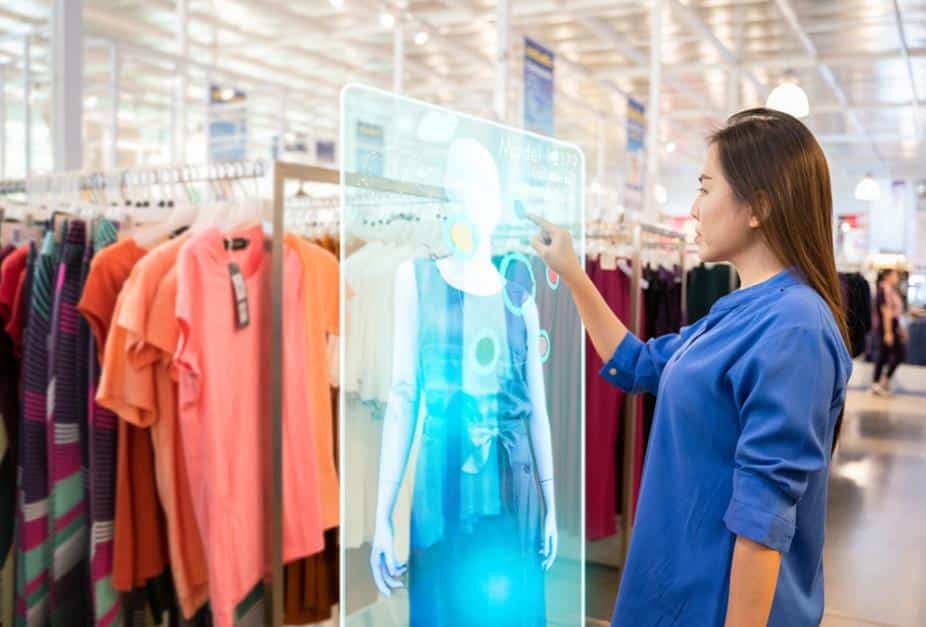
Augmented reality (AR) technology is a promising frontier for integrating brick-and-mortar stores into the digital economy. It’s the same technology that enables games like Pokémon Go—apps that use your phone’s camera to show you your world overlaid with information from an app. These apps use advanced AI to automatically map dynamic displays onto our environments.
In an AR-enabled store, a shopper could examine an object using their phone’s camera, and an app could show them nutrition facts, reviews, features, or almost any other relevant information you can imagine. A digital assistant could help them navigate large and confusing spaces like malls and box stores. AR apps could help furniture shoppers visualize a chair in their living room or clothes shoppers see a suit on their body.
The options are nearly limitless for a business willing to apply some resources. So, while building an AR experience for stores is still quite pricey and labor-intensive, the technology’s versatility makes it an appealing option for businesses with the resources to do it effectively at scale.
3. Dynamic Pricing: AI Is Transforming Brick and Mortar Retail
Dynamic pricing is a model in which retail prices change regularly according to supply, demand, competition, and other variables. Amazon famously uses this strategy to great effect, but it’s rarely been on the table for brick-and-mortar merchants until now. But as brick-and-mortar increasingly struggles to compete with online shopping, the advantages of dynamic pricing are becoming too tempting to ignore.
Those advantages are numerous. Retailers could link their prices to their competitors, account for demand surges in real time, or instantly set discounts on items that will be past their date soon. And store employees would no longer have to spend time changing shelf labels, as those labels would almost certainly be replaced with electronic shelf labels (ESLs) that do the job for them.
So, what are retailers waiting for? One big obstacle is the substantial investment in technology, from ESLs to the algorithms themselves that set prices. On top of that, it’s not clear how customers might react to prices that change constantly. Still, as enterprise AI technologies become ever more accessible, there’s a strong chance more retailers will soon take the plunge with experiments in dynamic pricing for in-store shopping.
4. Stock Replenishment
Stock-outs are devastating to brick-and-mortar retailers. When shoppers can’t find what they need, retailers don’t just lose a sale, but they may lose a customer’s business permanently. To improve the reliability and flexibility of their supply chains, many retailers are turning to AI and predictive analytics.
Algorithms can help businesses predict seasonal demand fluctuations, shipping bottlenecks, and other supply chain challenges. What’s more, they can also help with inventory management by automatically counting inventory and setting reorder conditions. For example, an electrical parts retailer could tell its algorithm to automatically reorder NEMA 6P enclosures.
When businesses can predict stock-outs and supply chain issues more accurately, they can plan for them more effectively. In turn, that helps keep products on shelves and improves customers’ ability to find what they need. That’s good for consumers, good for retailers, and good for the economy.
5. Everyday Automation
Even outside of the big, splashy AI technologies, automation “around the edges” can produce a more pleasant experience for both shoppers and employees. Automating repetitive tasks allows employees to spend less time on things like counting stock and changing price labels. That means they can spend more time helping shoppers and delivering an experience that makes them customers for life.
Ultimately, that’s the thing to remember about automation for brick-and-mortar retail: It should serve the purpose of faster, easier, and more pleasant customer experiences. Retailers should carefully examine the most optimal use cases for automation in their brick-and-mortar spaces and think with the customer in mind. When in doubt, it’s a good idea for retailers to start small and use automation to smooth over the little friction points in their customer experience.